The hidden choreography between vehicle, battery, and infrastructure that determines charging time – and how smart manages the balance.
jpg
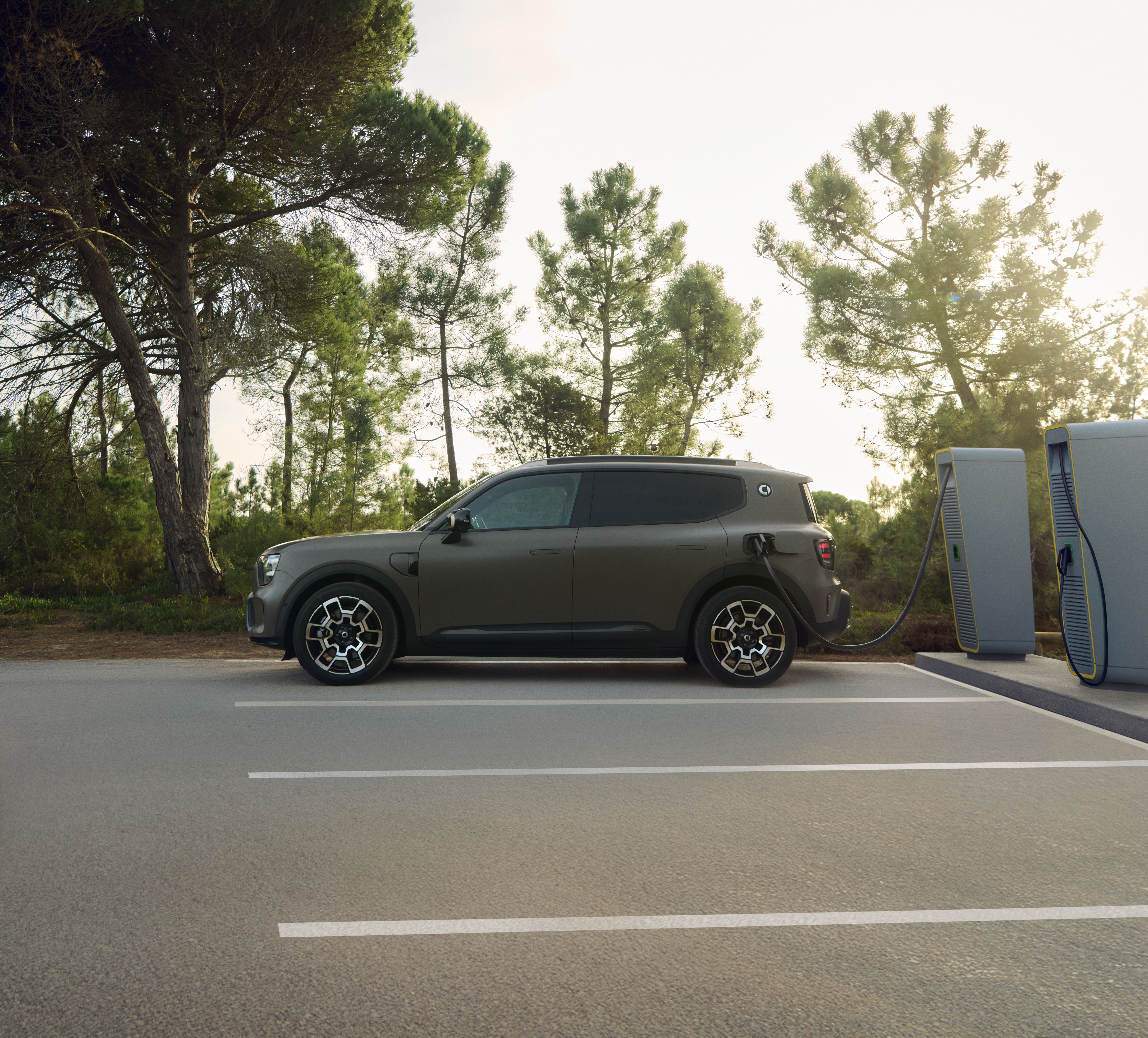
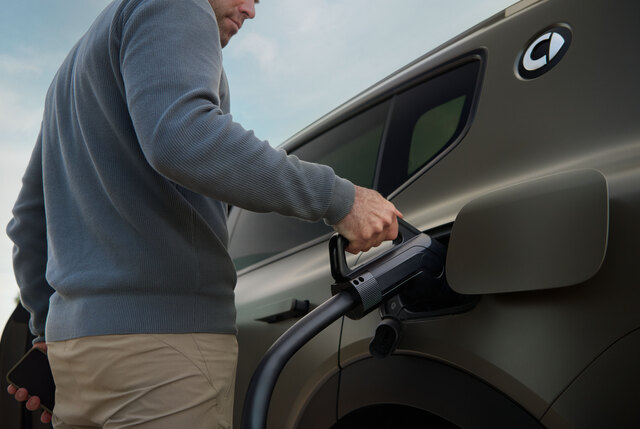
It's a Tuesday morning at a fast-charging station between Stuttgart and Munich. A smart #5 plugs in at 10 percent State-of-Charge (SOC). Eighteen minutes later, the display shows 80 percent SOC. Time for a coffee, a quick phone call, and then off again. Fast charging works – when the right conditions converge.
What conditions? The charging time of an electric vehicle depends on the charging power in kilowatts (kW) actually transferred to the car. This is influenced by several parameters, including the vehicle’s technology, the capability of the charging infrastructure, battery temperature, and current SOC. No single factor determines performance alone. It's the intelligent interplay of all these factors that counts.
800 Volts: The Foundation for Fast Charging
The smart #5 employs 800-volt high-voltage technology – an architecture developed specifically for larger battery capacities and maximum charging power. The physics is straightforward: doubling the voltage from 400 to 800 volts halves the current required for the same power output. Less current means lower losses in cables and connectors, more efficient energy transfer, and reduced heat generation.
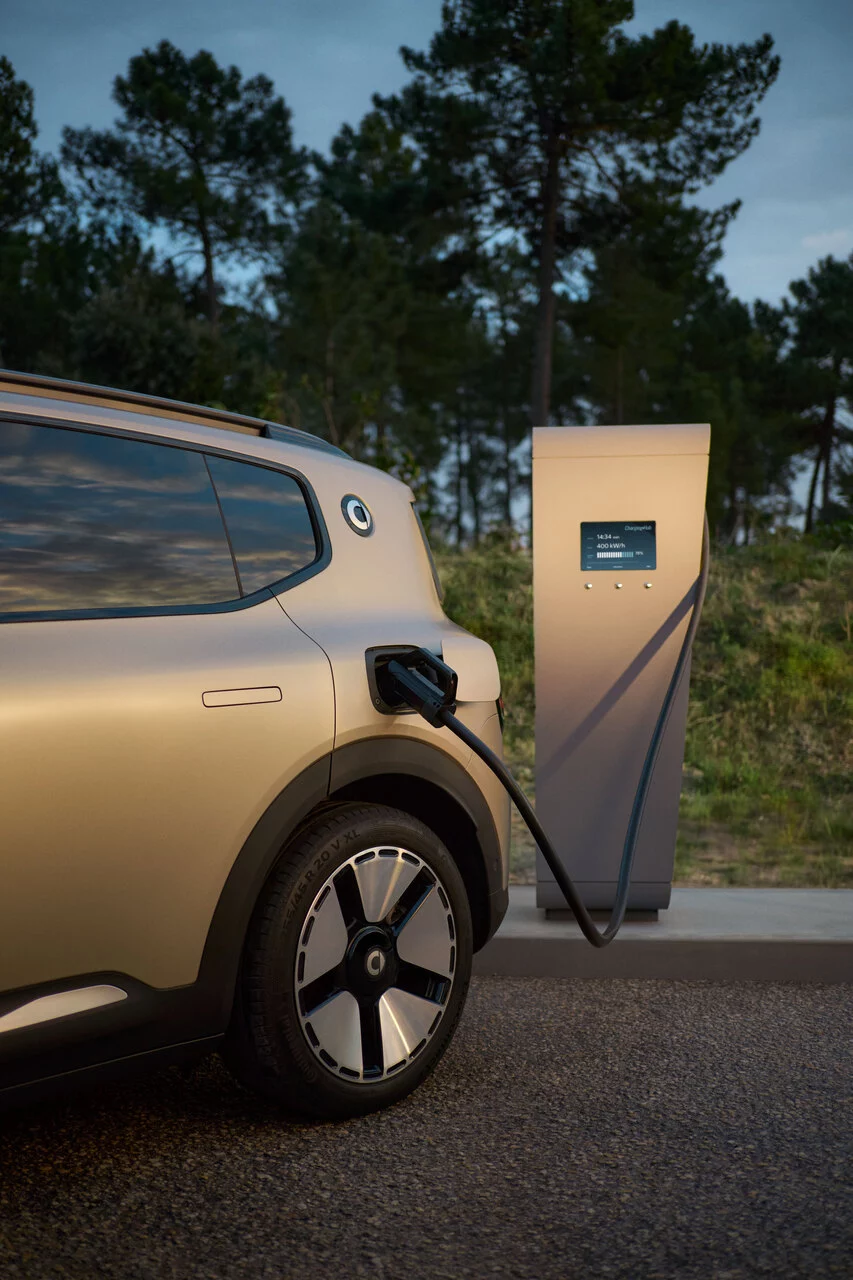
The result: The 800V system enables the smart #5 with its 100-kilowatt-hour battery1 to achieve charging power of 400 kW – and thus ultra-fast charging times of 18 minutes from 10 to 80 percent SOC under optimal conditions2. Real-world output, however, is determined by additional factors, some of which lie beyond the vehicle manufacturer's control.
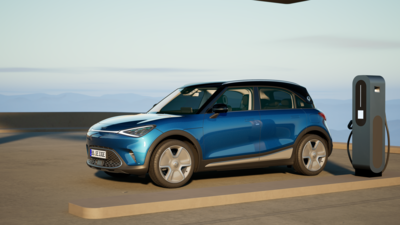
Animated video showcasing the smart #5 and its advanced 800-volt architecture.
Charging Infrastructure: The External Component
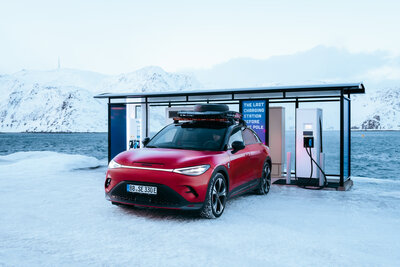
Even the most advanced vehicle technology requires appropriate fast-charging stations to realize its potential. To achieve maximum power, the smart #5 is engineered for infrastructure capable of delivering up to 600 amperes and 400 kW – positioning it at the forefront of charging technology. In practice, most of today's high-power charging stations across Europe deliver up to 500 amperes. But according to tests, the difference between a 500-ampere and a 600-ampere charger just amounts to approximately 20 seconds on a 10-to-80-percent charge – entirely negligible for everyday use. Below 500 amperes, charging times increase gradually as available current decreases – a natural physical relationship that applies to all electric vehicles.
This means drivers can charge confidently at today's infrastructure while the smart #5 is fully prepared to harness the growing network of ultra-high-power stations across Europe.
When planning longer journeys, the navigation system in the all-electric smart vehicles doesn't just guide to the destination. The integrated charging planner suggests optimal charging stops along the route, taking into account the current battery level, distance to destination, and the availability of charging stations. Stations can be filtered by charging power, connector type, or preferred networks, ensuring the right charger is found, when needed. With regular over-the-air (OTA) map updates and live charging station availability, the system keeps pace with Europe's rapidly expanding charging infrastructure.
Another aspect: charging stations themselves are subject to thermal limits. Modern DC fast chargers have internal protection mechanisms that can temporarily adjust power under continuous load to prevent overheating. High ambient temperatures – particularly above 30° to 40° degrees Celsius – intensify this effect. Users typically see only reduced kilowatt readings on the display, which can feel like unexplained performance loss. Yet this external factor lies entirely beyond the vehicle's control.
Additionally, many fast-charging stations share their total capacity between multiple sockets. When a second vehicle charges at the neighboring connector, available power decreases for both. This, too, is normal and known to experienced EV drivers though rarely communicated.
jpg
Battery Temperature: Best Between 20 and 35 Degrees Celsius
Back to the factors within the vehicle: lithium-ion cells operate most efficiently within a specific temperature window, typically between 20 and 35 degrees Celsius. Within this range, the battery accepts high charging currents without compromising longevity.
The thermal management system in smart vehicles continuously monitors cell temperature and adjusts the strategy accordingly. In winter, preconditioning actively warms the battery – the vehicle prepares for charging before the plug is connected. In summer, the system actively cools to maintain cells within the ideal range.
How can drivers optimize this? When setting a charging station as the destination in the navigation system, the smart automatically initiates battery preconditioning. The vehicle calculates arrival time and begins thermal preparation accordingly . The preconditioning status is visible in the vehicle's energy display, signaling through symbols whether the battery is too hot and currently being cooled down (heating symbol), too cold and heated up (snowflake symbol), or in optimal condition for charging. The battery pre-conditioning and thermal management system work silently in the background, ensuring maximum charging power from the moment the plug connects.
This active temperature regulation maximizes charging power at the relevant moment whilst simultaneously protecting the battery throughout its entire service life. The result: consistent performance, even after years of intensive use.
jpg
png
jpg
png
jpg
Understanding the Curve
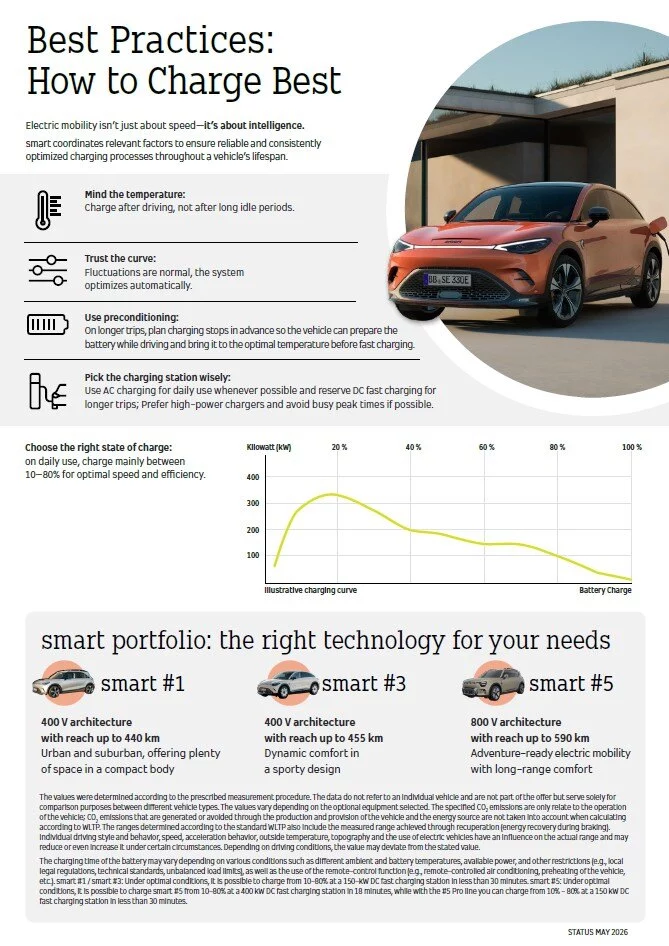
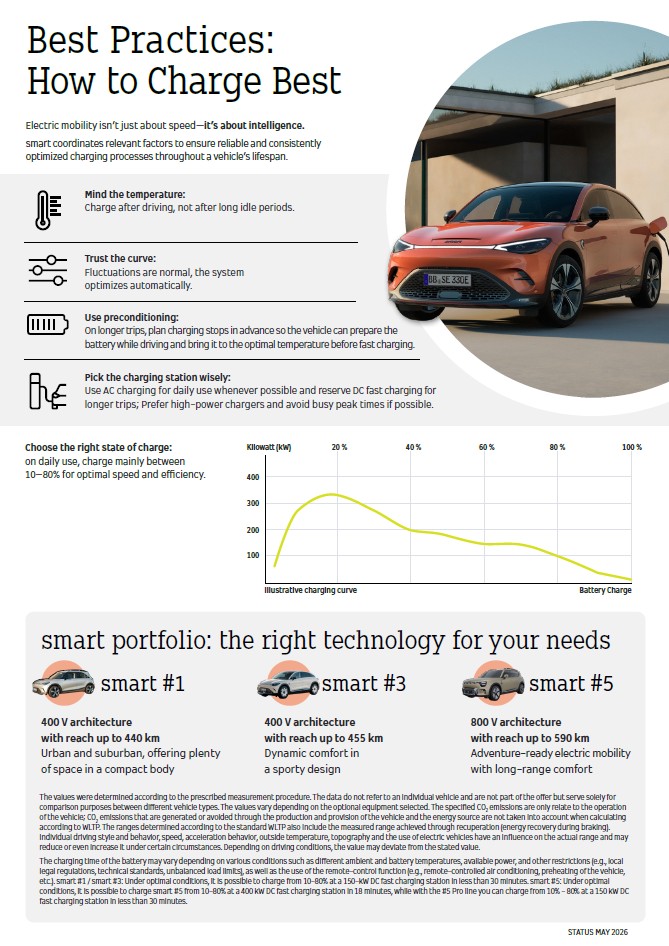
The State of Charge (SOC), the battery's current charge level, decisively influences charging performance. Between 10 and approximately 60 percent, the battery draws the highest currents. This is the range where fast charging reveals its potential.
Above 60 percent, the charging curve deliberately flattens. This is a conscious strategy for cell protection. At 80 percent, the process slows significantly – the ideal moment to continue long journeys.
This characteristic curve balances speed in the relevant range with longevity across the entire life cycle.
Range in Practice: Why Charging Speed Matters
WLTP range figures provide standardized comparability under controlled laboratory conditions. Real-world range, however, depends on individual factors: motorway speeds, cold winters, mountainous terrain, and driving style all influence consumption. This variability isn't unique to smart – it's a physical reality for all electric vehicles.
What matters is how manufacturers respond to it. The smart approach: instead of chasing ever-larger batteries that add weight and cost, smart focuses on intelligent charging infrastructure integration and fast charging capability, especially in the smart #5. When recharging becomes a seamless journey interruption rather than a range anxiety, shorter stops transform from compromise to convenience.
jpg
jpg
jpg
jpg
Tailored Concepts: smart #1, #3, #5 Compared
The all-electric smart models each bring a charging and battery concept tailored to their purpose, target audience, and everyday use – demonstrating that intelligent electromobility means more than just specs. While at AC wall boxes, all current smart models charge at 22 kilowatts – ideal for overnight charging at home – they differ in their tailored charging concepts.[3]
The smart #1 – optimized for urban everyday life
The compact all-rounder employs 400-volt architecture with either 47 or 62 kilowatt-hours net capacity depending on the product line. This provides up to 440 kilometers range (WLTP) depending on configuration – perfectly calibrated for urban and suburban daily routines. The concept: a battery size that balances weight, efficiency, and practicality for those who value a sustainable, versatile vehicle for everyday mobility. With up to 150 kilowatts DC power, the smart #1 charges from 10 to 80 percent in under 30 minutes – fast enough for spontaneous errands or weekend getaways.
The smart #3 – aerodynamics meets performance
The smart #3, the particularly dynamic model, shares battery technology with the #1 but takes a different approach: thanks to its excellent aerodynamics and coupé-like silhouette, it achieves 455 km (Premium) according to WLTP – extracting maximum range from the same 66 kWh battery through intelligent design. The concept here is clear: performance-oriented drivers benefit from athletic acceleration combined with efficiency gains through optimized airflow. Like the #1, the smart #3 employs proven 400-volt architecture, optimally calibrated for its performance class – a deliberate choice that keeps the vehicle lightweight, agile, and perfectly suited for dynamic driving on both urban streets and winding roads.
The smart #5 – the flagship for long distances and adventures
The concept behind the smart #5 is ambitious: meeting the needs of families and adventurers who require space, versatility, and the confidence to tackle longer journeys without range anxiety. It has a long-range battery with a net capacity of 94 kilowatt hours, enabling a range of 590 km according to WLTP (Premium Line). But the real innovation lies in its 800-volt architecture: this platform resembles already the future of charging, where charging stops take almost the same time as those for conventional refueling, making it a natural break on the journey – only electric, clean, and quiet.
5 Simple Strategies to Maximize Your Charging Experience
With its all-electric portfolio, smart demonstrates that modern charging technology is not a one-size-fits-all proposition – it's a question of intelligent concepts matched to real-world needs.
The smart #1 and #3, with their proven 400-volt architecture, offer compact batteries and fast charging times perfectly calibrated for urban and suburban mobility.
The smart #5 pushes boundaries: its 800-volt architecture and 100 kWh battery are designed for those who demand more range, versatility, and the freedom to venture further. With ultra-fast charging capable of 18 minutes from 10 to 80 percent under optimal conditions, it transforms longer journeys from logistical challenges into seamless experiences.
But technology alone isn't enough. What sets smart apart is how these vehicles intelligently orchestrate all the factors explored in this article: battery temperature pre-conditioning ensures optimal charging readiness, integrated navigation with charging planning suggests the right stops at the right time, and intelligent thermal management protects the battery throughout its service life. The system adapts in real time to infrastructure capabilities, ambient conditions, and state of charge – balancing performance with longevity.
We've developed a system that delivers peak performance under optimal circumstances whilst intelligently adapting to different realities. The technology is ready for ultra-fast charging – and protects itself when required.
Dr. Tilo Schweers, Vice President R&D at smart Europe
For customers, this means confidence: Whether navigating city streets in a smart #1, enjoying dynamic performance in a smart #3, or embarking on a family adventure in a smart #5, the charging experience is predictable, reliable, and continually optimized. The navigation guides to compatible stations, the battery prepares itself for optimal charging, and the system ensures consistent performance throughout the vehicle's entire service life.
The future of electric mobility isn't just about speed – it's about intelligence. And with smart's tailored concepts, that future is already here.
Find out more: Full details on charging capacities and technical specifications of the smart model range at smart.com.
Disclaimers:
1With the exception of the smart #5 Pro with 76 kWh battery and 150 kW charging power, which under optimal conditions can charge from 10% to 80% in 30 minutes.
2The charging time of the battery may vary depending on various conditions such as different ambient and battery temperatures, available power and other restrictions, as well as the use of the remote control function (e.g. remote controlled air conditioning, preheating of the vehicle, etc.). smart #1 / smart #3: Under optimal conditions, it is possible to charge from 10-80% at a 150-kW DC fast charging station in less than 30 minutes. smart #5: Under optimal conditions, it is possible to charge smart #5 from 10-80% at a 400 kW DC fast charging station while #5 Pro line you can charge from 10% - 80% at a 150 kW DC fast charging station in less than 30 minutes.
3The values were determined according to the prescribed measurement procedure. The data do not refer to an individual vehicle and are not part of the offer but serve solely for comparison purposes between different vehicle types. The values vary depending on the optional equipment selected. The specified CO₂ emissions are only relate to the operation of the vehicle; CO₂ emissions that are generated or avoided through the production and provision of the vehicle and the energy source are not taken into account when calculating according to WLTP. The ranges determined according to the standard WLTP also include the measured range achieved through recuperation (energy recovery during braking). Individual driving style and behavior, speed, acceleration behavior, outside temperature, topography and the use of electric vehicles have an influence on the actual range and may reduce or even increase it under certain circumstances. Depending on driving conditions, the value may deviate from the stated value.